Sermorelin dosage: mL, study regimens and duration
Amount, concentration and time answer different questions. The published studies are specific about their own subjects; they cannot select a dose for a reader.
Sermorelin dosage in mL
A millilitre measures liquid volume. A study amount stated in micrograms or milligrams measures the amount of compound. The concentration of a preparation connects the two, so a volume alone cannot identify the amount administered.
I won’t invent a concentration to make a neat mL answer. The cited studies below report their own amounts, populations and routes. This page provides no mixing calculation, syringe conversion or human dose recommendation. Questions about an individual prescription require the prescriber and dispensing pharmacy to establish the actual preparation.
Sermorelin dosage for children
The historical pediatric efficacy study used 30 mcg/kg/day subcutaneously at bedtime in children with GH deficiency. The reported first-year height velocity increased from about 4.1 cm/year to roughly 7–8 cm/year. Weight-based notation records how that study assigned the amount.
The comparative pediatric study examined 30 or 60 micrograms/kg/day for 6 months. These are historical study regimens with specific participants and clinical oversight. They provide no basis for selecting a child’s treatment from a webpage. I consider that boundary particularly important here: the published growth outcome is concrete enough to tempt a much broader application.
Adult and pharmacokinetic study amounts
In the older-men endocrine study, researchers gave 0.5 mg and 1 mg subcutaneously twice daily for 14 days. The measured outcomes were 24-hour GH and IGF-1, with fasting glucose unchanged. The experiment’s purpose and duration travel with those figures.
The pharmacokinetic study in 30 healthy men used intravenous amounts of 0.25–2 mcg/kg. Significant GH release occurred at 0.25 mcg/kg, with maximal release at 1–2 mcg/kg. Intranasal bioavailability was only ~3–5%. Bioavailability is the share that reaches the circulation; route made a substantial difference in this experiment.
I would resist arranging these amounts into a ladder from weaker to stronger. Different routes and study populations prevent that tidy comparison. The low intranasal result also leaves oral and sublingual formulations needing their own evidence.
Sermorelin half-life
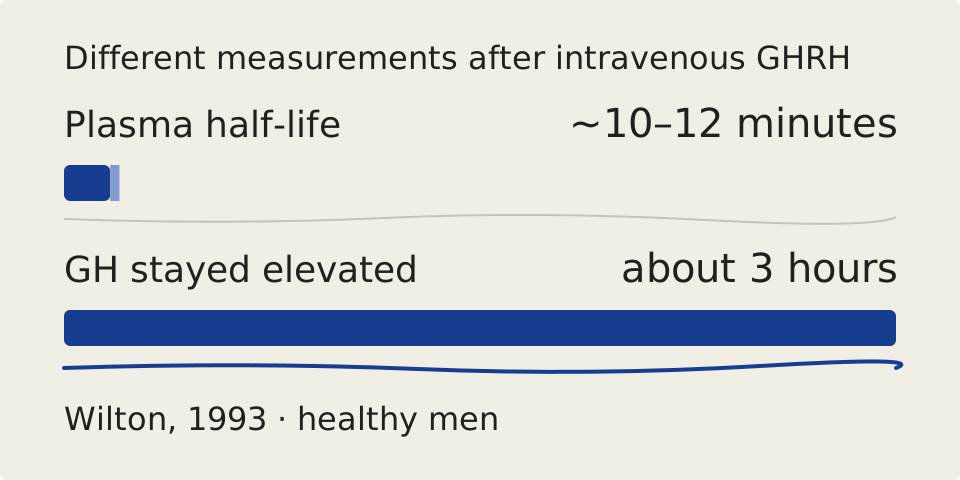
The reported intravenous plasma half-life was ~10–12 minutes, while GH remained elevated for about 3 hours. The short interval concerns the peptide in plasma; the longer one concerns the hormone response. Neither measurement supplies a sports-testing window.
The gland’s behavior after that stimulus still needs explaining. That is why the continuous-infusion finding matters alongside attempts to make GHRH analogs last longer.
Sermorelin acetate and glycine dosage questions
Sermorelin acetate names the acetate form of the GHRH fragment described in the GHRH review. That name alone leaves concentration and intended clinical use unspecified. “Sermorelin glycine dosage” adds another ingredient to the question, but the papers listed here supply no clinical dosing study of that combination.
I have no sourced combination regimen to offer. Substituting a familiar sermorelin study amount would conceal that gap. The same care applies to claims made for tablets or other delivery forms: the old route study cannot establish a new formulation’s performance.
Sermorelin dosing duration and dosage cycle
The older-men experiment ran for 14 days; the child-growth trial measured the first year. Their durations served different endpoints. The continuous-infusion study adds an especially important complication: the response declined during prolonged exposure.
There is no established adult course length in this record, including a universal three-month cycle. I’m interested in duration as an experimental variable, with benefits and harms followed together. A search for “sermorelin dosage cycle” cannot turn those unlike experiments into a schedule.